
Last updated October 30, 2026
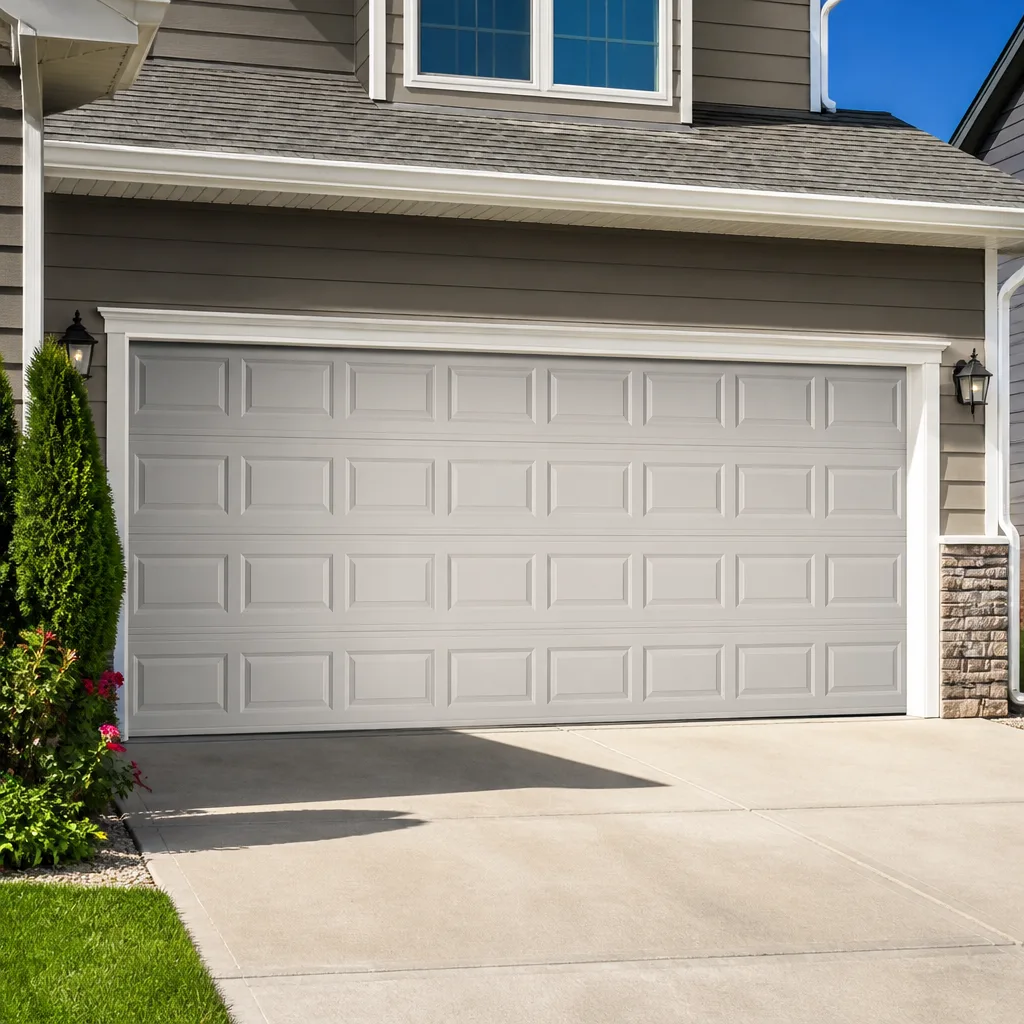 Raised-panel steel
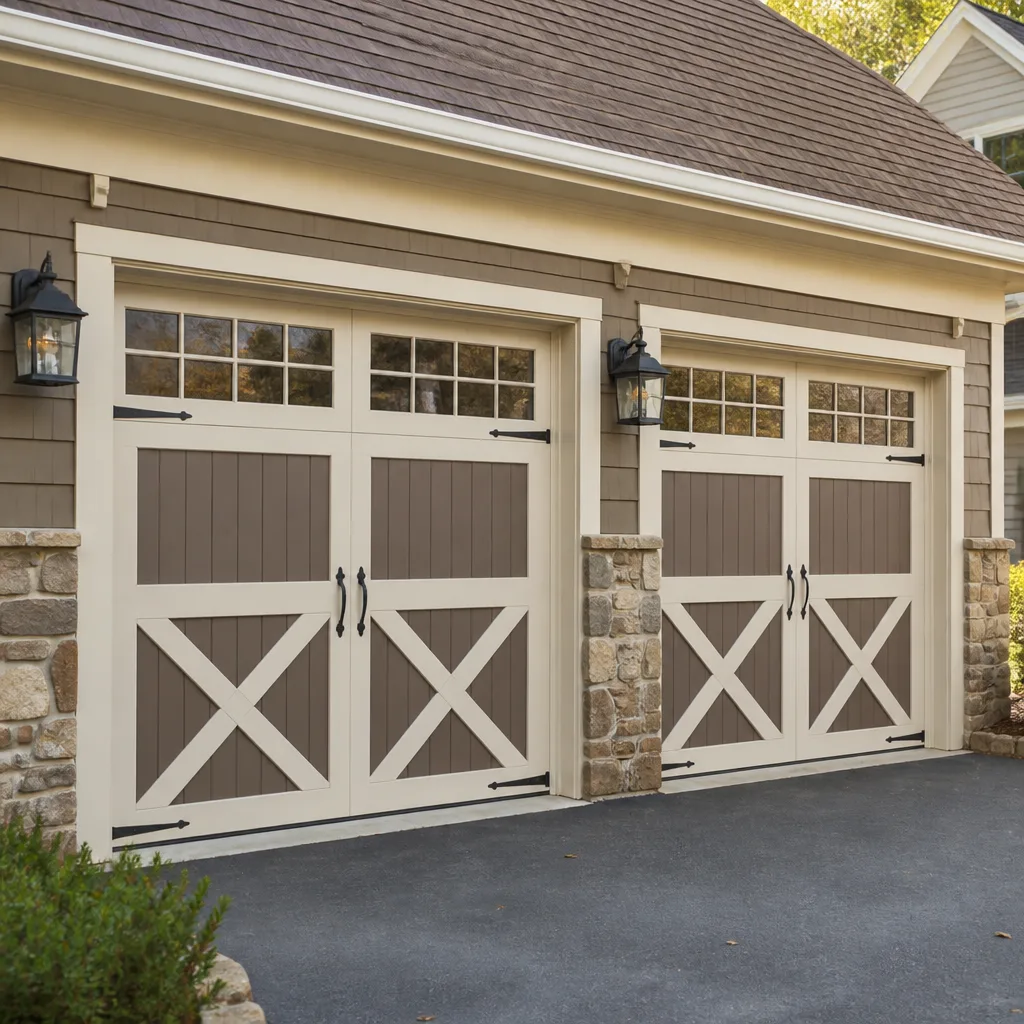 Carriage house
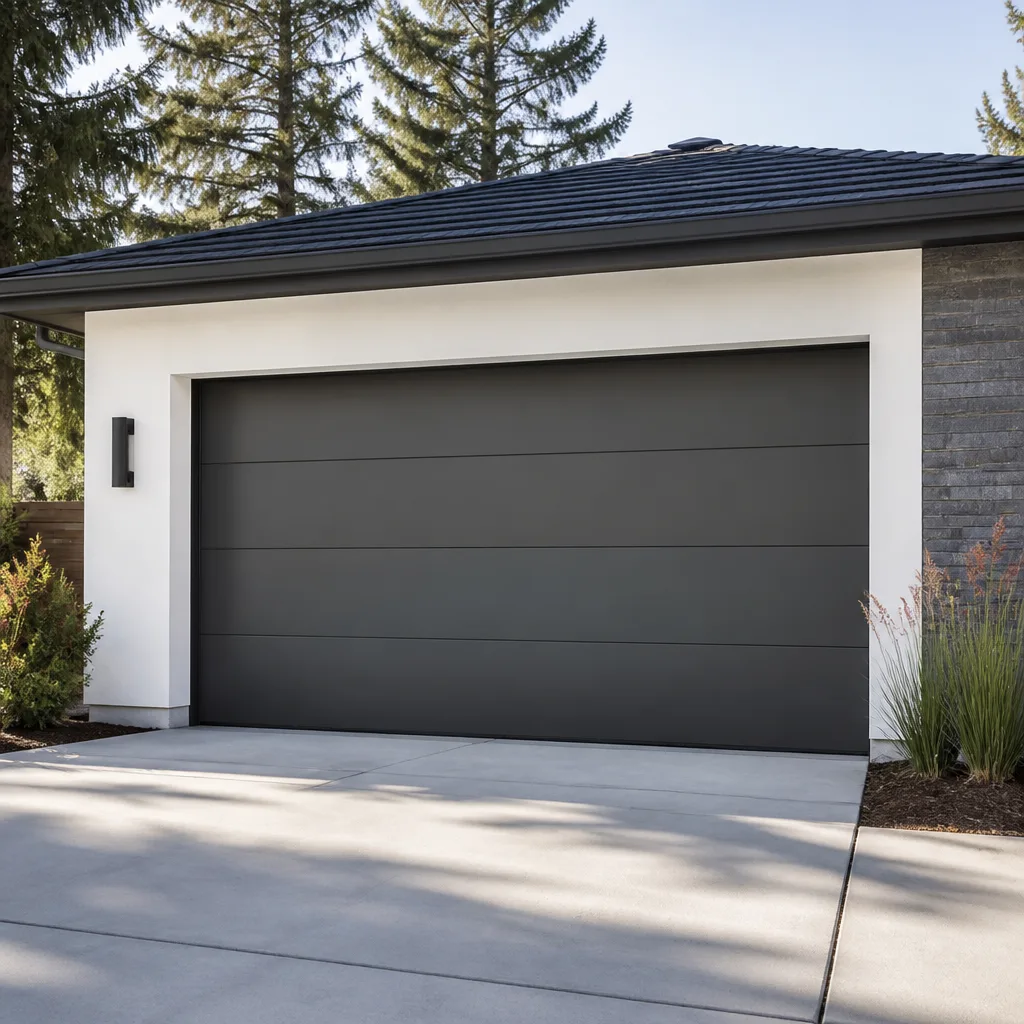 Modern flush
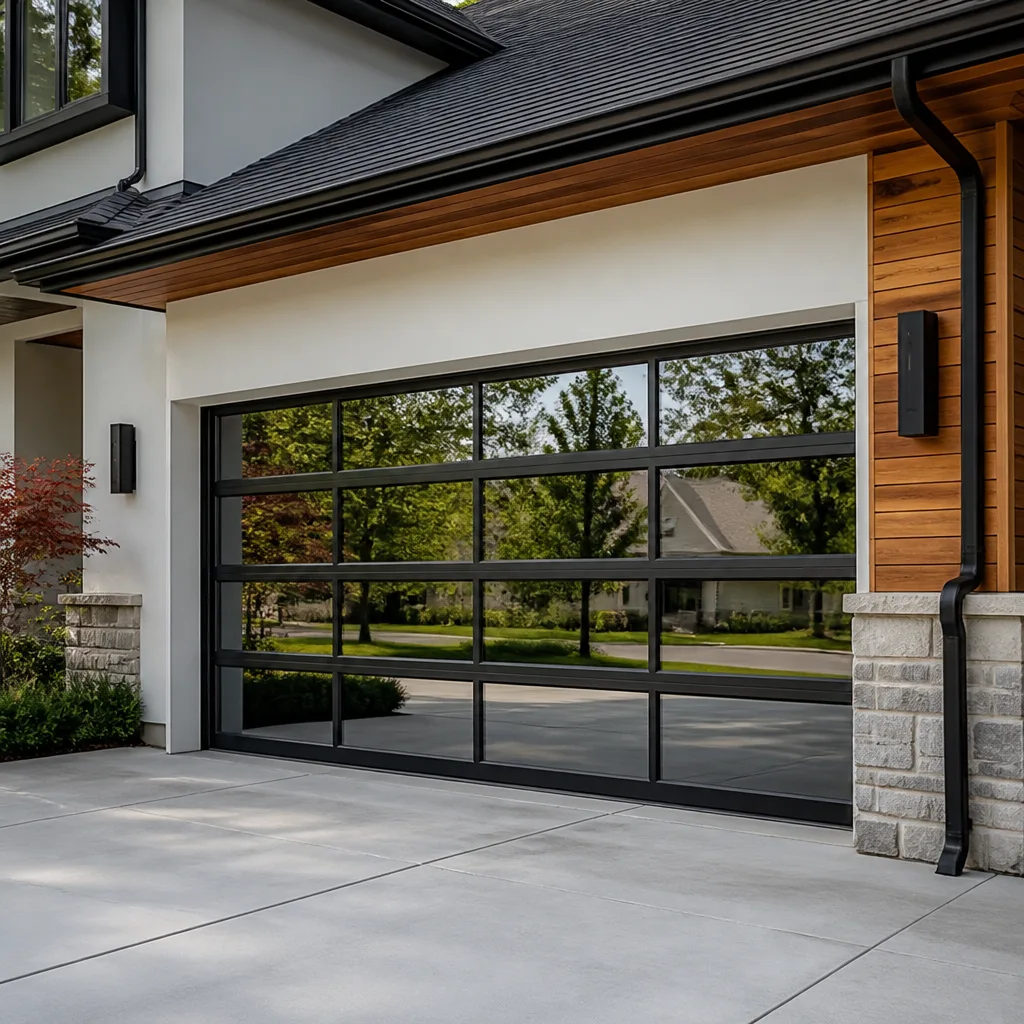 Full-view glass
 LiftMaster openers
 Chamberlain openers
Full 25-point door and opener safety check with every visit - springs, cables, rollers, tracks, and your LiftMaster or Chamberlain opener included
You get a price before we start. It does not change when the truck arrives.
Get your free estimateGarage Door Emergency Preparedness Guide for Miami Homes
Here’s a number most Miami homeowners don’t know: after Hurricane Andrew flattened parts of South Dade in 1992, FEMA’s structural engineers identified garage door failure as the leading cause of catastrophic roof loss. When the garage door blows in, the wind pressure inside the house spikes, and the roof lifts clean off. Thirty-plus years later, walk down any street in Kendall, Pinecrest, or Coral Gables and count how many homes have hurricane shutters on the windows but a garage door that’s never been inspected since installation. This guide covers what actually matters: how to prepare your garage door before a storm, how to operate it safely when the power dies, what those wind-load labels really mean, and how to document damage for your insurance adjuster. We’re writing this from Miami because we work on these doors every week, and we know which failures repeat themselves season after season.
Quick Answer
Garage door emergency preparedness in Miami means three things: knowing how to disconnect and manually operate your door during a power outage safely, confirming your current door meets the wind-load requirements for your specific area (Miami-Dade sits in a High Velocity Hurricane Zone, with stricter standards than Broward or Palm Beach), and completing a pre-storm inspection so you’re not discovering a broken spring or rusted track the afternoon before landfall. A door that fails in a hurricane isn’t an inconvenience; it’s how houses lose roofs. The steps below take less than an hour and could save the entire structure.
Styles & brands we work with
Table of Contents
- How to Operate Your Garage Door Safely During a Power Outage
- What “Hurricane Rated” Actually Means for Your Miami Garage Door
- Pre-Storm Protocol: The Correct Sequence Before a Storm Approaches
- Post-Storm Inspection: What to Check Before Operating the Door
- The Emergency Release Cord: What It Does and the Mistake That Locks You Out
- How to Document Garage Door Storm Damage for an Insurance Claim
- Common Mistakes to Avoid
- When to Call a Professional
How to Operate Your Garage Door Safely During a Power Outage
Every automatic garage door opener in Miami has a manual release mechanism, usually a red cord hanging from the trolley that connects the door to the opener rail. Pulling that cord disengages the opener so you can raise and lower the door by hand. But here’s the part most people get wrong, and it’s the reason we get emergency calls after every outage: the emergency release only works when the door is in the closed position and the spring tension is balanced correctly. If you pull the release while the door is mid-travel or if the springs are worn, a heavy garage door can slam down with enough force to break a leg or crush a hand. A standard 16-foot steel door weighs 150 to 250 pounds.
The correct sequence during a Miami power outage, whether it’s a quick FPL flicker or a week-long post-hurricane blackout:
- Confirm the door is fully closed. If it’s open and the power is out, do not pull the release. If the springs are healthy, you may be able to assist the door down by hand, but call a technician if it feels heavy or uneven.
- Pull the red emergency release cord down and toward the opener. You’ll hear a click as the trolley disengages. The door is now in manual mode.
- Lift the door using the handles or the bottom edge only. Test the weight first. It should lift smoothly with moderate effort. If it feels like dead weight or drops when you let go, the springs are shot and you should not proceed. That’s a Garage Door Repair in Miami call before you touch anything else.
- When raising the door manually, keep your feet clear of the bottom panel. Lift in one continuous motion to the fully open position, and make sure the track rollers are seated before releasing.
- To close manually, reverse the motion and guide the door down. Never let it free-fall. If it starts to drop on its own, your springs need attention.
- Once power returns, re-engage the opener by pulling the release cord down and toward the door, or by pressing the opener wall button if it has an automatic re-engage feature. The trolley will click back into place on the next cycle.
The mistake that locks people out or in? Pulling the release cord while the door is open. The door may drop a few inches and then the release mechanism jams. Now you have a door that’s neither fully open nor fully closed, and you can’t get your car out. In Miami’s storm season, when you’re trying to evacuate before feeder bands arrive, that’s the last thing you need.
What “Hurricane Rated” Actually Means for Your Miami Garage Door
If you bought your home new in Miami-Dade after about 2002, or if the garage door was replaced under permit, it almost certainly carries a wind-load label that satisfies the High Velocity Hurricane Zone requirements in the Florida Building Code. But if your door is older, or if a previous owner installed something without pulling a permit (we see this regularly in older neighborhoods like Shenandoah, Buena Vista, and Silver Bluff), you may have a door that wouldn’t pass current code.
“Hurricane rated” isn’t a marketing phrase. It means the door assembly, including the panels, tracks, hinges, and header hardware, has been tested to withstand a specific design pressure, measured in pounds per square foot (psf). In Miami-Dade, the requirement for most single-family residential garage doors is a design pressure rating sufficient for the wind speed map in the current code, typically in the range of ±40 to ±60 psf depending on exposure and the house location.
Here’s what to look for:
- A metal label or sticker on the door section, usually near the top or bottom edge of a panel, that lists the design pressure rating, the manufacturer, and a Miami-Dade NOA (Notice of Acceptance) number. If you see an NOA number, the door is approved for use in Miami-Dade and Broward. If the label is missing or painted over, we can sometimes identify the manufacturer from the hinge pattern and panel profile. Garage Door Installation in Miami done properly will always include this documentation.
- Braced or reinforced stiles in each panel. Wind-rated doors from Amarr and Wayne Dalton, for example, use heavier-gauge steel or added internal bracing compared to non-rated versions of the same model.
- Reinforced tracks and heavier bracket hardware. The track itself doesn’t take the direct wind load, but it keeps the door on its path when the panels flex. In our experience, track separation is a common failure mode on under-built doors in the more exposed areas east of US-1, like Coconut Grove and Key Biscayne.
Design pressure, in plain terms: imagine a giant hand pressing against the door from outside. A 40 psf rating means the door is tested to resist 40 pounds of pressure on every square foot of its surface without deflection beyond the code limit. For a standard 16-foot by 7-foot door, that’s roughly 4,480 pounds of total force. A 60 psf rating pushes that to over 6,700 pounds. That’s the difference between a door that holds and a door that folds inward at the first strong gust.
If you’re not sure what your door is rated for, look for the label before storm season, not during. If there’s no label, and the door is visibly older or was clearly a homeowner install, assume it’s not wind-rated and plan accordingly. That doesn’t necessarily mean replacing it today, but it does mean you should know what you have.
Pre-Storm Protocol: The Correct Sequence Before a Storm Approaches
When a named storm is forecast for Miami, you’ll see a predictable pattern: plywood goes up on windows, gas lines form, water shelves empty at Publix. The garage door rarely makes the list. But Miami-Dade building officials have been saying for two decades that the garage door is the weak point in the building envelope. Here’s the sequence we recommend, and it’s the same one we walk through with clients every June.
Step One: Full Visual Inspection (Allow 15 Minutes)
With the door closed, walk the entire perimeter, inside and outside. You’re looking for anything that wasn’t there last time you looked:
- Gaps between the door panels and the jambs (side framing) that are wider than a pencil
- Loose or missing hinge bolts where panels connect
- Rust or corrosion on the tracks, especially at the bottom corners (salt air near the coast accelerates this)
- Worn or fraying cables on either side; if one cable shows a single broken strand, the door is one gust away from coming off its track
- Visible wear or separation in the torsion spring above the door
- Debris in the tracks, especially after wind events
If you find a frayed cable, a broken spring, or a track that’s shifted, that’s a repair before the storm, not after. Wind-load performance assumes the hardware is intact. A door with one broken spring has roughly half the intended resistance, because the remaining spring is doing the work of two and the door sits unevenly in the opening.
Step Two: Run a Full Cycle Test
Open and close the door once using the opener. Listen. A properly adjusted door is quiet aside from the opener motor. A door that’s grinding, shaking, or stopping and reversing on its own is telling you something. Also watch the door as it travels: it should move smoothly with no hesitation, especially at the midpoint where it would change direction. If the opener reverses on its own near the floor, the force settings or photo-eye alignment have drifted, and that’s a Garage Door Opener Repair in Miami fix that often takes us under an hour.
Step Three: Decide Your Bracing Strategy
If your door carries a valid Miami-Dade NOA and was installed under permit, the Florida Building Code considers it sufficient without supplemental bracing. If it’s older, unlabeled, or you’ve had it flex visibly in previous storms, you have three options, from most to least effective:
- Install a code-approved vertical bracing kit. These aluminum or steel posts mount inside the garage and pin the door to the floor and header. We’ve installed these on homes in Coral Terrace and Westchester where owners wanted the security without a full door replacement. Kits from Amarr and other manufacturers are tested as systems with specific doors, so don’t mix and match blindly.
- Install a temporary 2×4 bracing system. The Miami-Dade and FEMA technical guides detail how to anchor vertical studs into the floor and header. This takes time and tools, and it’s not something to first attempt at 10 p.m. the night before.
- Park vehicles against the door. Bumper against the inside face helps, but it’s not a substitute for engineering. A car’s bumper covers maybe a third of the door width, and the direct wind pressure on the rest of the door doesn’t care.
Step Four: Disconnect and Secure
Some Miami homeowners prefer to disconnect the opener before the storm (using the emergency release described above) so that the door is in manual mode and can’t be driven by the opener. But here’s the subtlety: a manually operated door in the down position without the opener trolley locked provides no additional wind resistance. The wind load is carried by the springs, tracks, and hinges, not the opener rail. What matters is whether the door hardware itself is sound. If you do disconnect, make sure you can re-engage it later. The cord should hang free and reachable.
Our position after years of hurricane seasons in Miami: the order of operations matters less than completing all of it. The homeowners who end up with the worst damage are the ones who meant to check the door but never got around to it until the storm was a day out and every technician in South Florida was booked solid.
Post-Storm Inspection: What to Check Before Operating the Door
After the storm passes and the power is back on, the temptation is to hit the wall button and see if everything works. Don’t, not yet. We’ve repaired doors across Miami-Dade and Broward where owners pressed the button first and asked questions later. The result was a door ripped off its track, a burned-out opener gear, or a snapped cable that whipped across the garage.
The correct post-storm sequence:
- Inspect the exterior first. Walk the door from outside and look for dents, panel separation, or debris wedged between the door and the frame. A palm frond in the track is a problem, but a panel dent is a larger one: bent panels bind in the track on the way up.
- Check the interior track alignment. Look at the vertical track from inside. It should be parallel to the wall, not bowed, twisted, or pulled away at the mounts. In Miami, several storms a season bring enough debris to knock even a well-built track out of alignment.
- Check the bottom edge and weather seal. Floodwater and debris often damage the rubber bottom seal first. A torn seal allows standing water, rodents, and leaves into the garage. Replacement is inexpensive, but it’s part of the complete door assembly when you’re filing a claim, so photograph it.
- Check the spring and cables. With the door still closed, look up. The torsion spring should be intact and centered. Both lift cables should be seated in their drums with no slack. If a cable is limp or hanging, the door is not connected to the spring system, and opening it manually is dangerous.
- If everything looks sound, disconnect the opener (manual release) and raise the door by hand to the midpoint. It should stay at the midpoint on its own if the springs are healthy. If it drops, the springs have failed or lost tension. Let it down gently and call a professional.
- Only after the manual test should you re-engage the opener and run a cycle. Stand clear of the door path, and watch and listen through the full open-close cycle.
In Miami, post-storm inspections also need to consider what’s not visible: saltwater intrusion. Homes near the water in neighborhoods like Edgewater, Morningside, and Surfside may have had saltwater in the garage, and those hinges, rollers, and bottom brackets will corrode within months if not cleaned and lubricated soon after. This accelerated corrosion is the slow, secondary failure that shows up in November or December, long after the claim window has closed.
The Emergency Release Cord: What It Does and the Mistake That Locks You Out
That red cord dangling from the opener rail, the one every Miami kids’ basketball has caught at some point, is the manual release. It exists for exactly the situation we’re covering: the power is out, the opener can’t run, and you need to get the door open. But the emergency release is also the source of a recurring problem we see after storms and blackouts.
The release mechanism works by disconnecting the opener trolley from the carriage that pulls the door. When the door is closed and the springs are healthy, pulling the cord lets the carriage separate, and you can lift the door by hand. The problem we’re talking about happens when a homeowner pulls the cord while the door is open, or partially open, or when a door hasn’t been properly re-engaged from a previous manual use.
What happens then: the trolley releases, but the door is mid-travel and the spring tension at that point is partially or fully wound. The door they were hoping to guide down drops, and the emergency release mechanism, which is designed for the closed-door position, binds against the carriage. The result is a door you can neither raise fully nor close fully. Homeowners call us from Kendall, Doral, and Hialeah describing exactly this scenario, usually trying to get the car out to get supplies or evacuate.
The fix that gets you back in operation:
- Stop forcing anything. Do not pull the cord harder, and do not jerk the door. You’ll make the problem worse.
- Check if the trolley can be re-engaged by moving the door gently a few inches by hand. Sometimes the door has simply settled into a bind, and a small lift or lower re-aligns the trolley and carriage.
- If the door is stuck open and you need it closed for security, assess the spring tension cautiously. A door that’s stuck open with a working spring system can sometimes be walked down by two people, one on each side, applying even pressure and not letting it drop. If the door feels like it wants to fall, don’t fight it. Secure the opening with a vehicle or temporary barrier and call us at (866) 282-5541. This is also how doors get bent frames when people pry on them with a shovel.
The mistake isn’t pulling the cord; it’s not understanding the position dependency. On LiftMaster, Chamberlain, and Genie openers alike, the release is designed to operate with the door in the closed position. We’d say the same to a homeowner with a Craftsman opener in Westchester or a Raynor door in Palmetto Bay. The hardware is different, the physics is the same.
How to Document Garage Door Storm Damage for an Insurance Claim
Insurance adjusters after a Miami hurricane are looking at thousands of the same claim: wind-driven rain, structural damage, garage door took the brunt. The homeowners who get claims approved quickly are the ones who document methodically. Here’s what we tell clients, and it mirrors what FEMA and the Florida Department of Financial Services recommend.
Before You Touch Anything: Photograph Everything
- Take wide shots first, from both inside and outside. The adjuster needs to see the door in context of the home. Date-stamp the photos if your phone doesn’t automatically.
- Photograph the door from straight on, edge on, and from the top looking down at the panels. Panel separation often only shows from the top-down view.
- Photograph the hardware. Tracks, cables, springs, hinges, bottom brackets, and the opener rail. The close-ups are the proof of storm-related failure versus pre-existing wear. An adjuster’s first question is always whether this was old or new damage.
- Photograph the label. If your door has an NOA label, get a clear photo. It establishes what was installed and its rating.
- Photograph any water marks on the interior walls or floor. This ties the door failure to the water intrusion and the repair scope.
Keep a Written Log
Create a simple note on your phone with the date of the storm, when you first noticed the damage, and every interaction with contractors or a public adjuster. If you get a repair quote, keep it. If we inspect the door in Hialeah or North Miami Beach and write an estimate, that estimate becomes part of your claim file.
What Adjusters Specifically Look For on a Garage Door Claim
- Consistent damage pattern. Wind damage should show as a single direction of force across the panels, not isolated dents in odd spots. A door with a clean vertical crease down the center suggests inward pressure. Random dents suggest rocks or debris.
- Track separation or deformation at the mount points. This is a classic wind claim. The door held, but the track mounts did not.
- Cable drum or spring damage. A snapped spring after a wind event is often covered, but the adjuster will want to know whether the spring was already worn. That’s why our repair reports in Miami include before-and-after notes on spring condition when we can.
One more point that saves Miami homeowners real money: if your door is damaged but the opening is secure, you don’t have to accept the first settlement and sign away the claim. Florida law gives you time, and the insurer’s obligation is to restore the property to its pre-loss condition, not to offer the cheapest possible replacement. If the door is unrepairable and your existing unit was wind-rated, the replacement should be wind-rated too. That’s not an upgrade; that’s like for like. We help clients document this distinction because the spec sheet and the door label together are the evidence.
Common Mistakes to Avoid
- Pulling the emergency release with the door open. This binds the trolley and leaves you stuck with a half-open door and a bigger problem. Always release it with the door closed.
- Assuming a code-compliant door means zero storm prep. Even a Miami-Dade NOA door needs its hinges torqued, its cables sound, and its tracks aligned. The rating assumes the door is in good condition, which it won’t be if it’s been neglected for a decade. We see this in older doors throughout Miami’s historic districts, where doors from the 1990s were solidly built but haven’t been serviced in years.
- Forcing a door that’s clearly binding. When a door is off track or the spring has failed, every attempt to raise or lower it by hand increases the damage and the injury risk. We’ve repaired doors in Cutler Bay where a homeowner bent three panels trying to force the issue, turning a spring replacement into a full door replacement.
- Ignoring the bottom seal after flooding. It doesn’t affect wind load, but a collapsed seal in a Miami garage that already took water is an open door for mosquitos, rodents, and continued moisture damage.
- Filing an insurance claim before documenting the door. Photograph everything before any repair work begins, even temp repairs. Once the door is changed out, your evidence is gone.
- Waiting until the storm is two days out to call for an inspection. From late June through October, every garage door company in Miami is at capacity during active storm periods. Spring maintenance in March or April beats an emergency repair in September.
When to Call a Professional
There’s a clear line between what a homeowner should handle and what genuinely needs a technician who works on garage doors daily. You should call a pro if: the door is visibly off track or the cables are loose, because those are under extreme tension; the torsion spring is broken, which is dangerous for anyone without the right winding bars and training; you’re dealing with a door that’s partially open and wedged, because it requires specialized tools to stabilize and realign; or you want a wind-load assessment on a door that has no label and therefore no documented rating. Some things are genuinely simple, like a torn weather seal or a misaligned photo eye. But springs and tracks under load are not DIY territory. We work on what you have, and if what you have is broken in a way that’s unsafe, we’ll tell you that over the phone before you make an appointment. Kingsway Garage Door offers free estimates in Miami. Call (866) 282-5541, and we’ll tell you honestly whether it’s an emergency or whether it can wait.
See the difference
 Before
 After
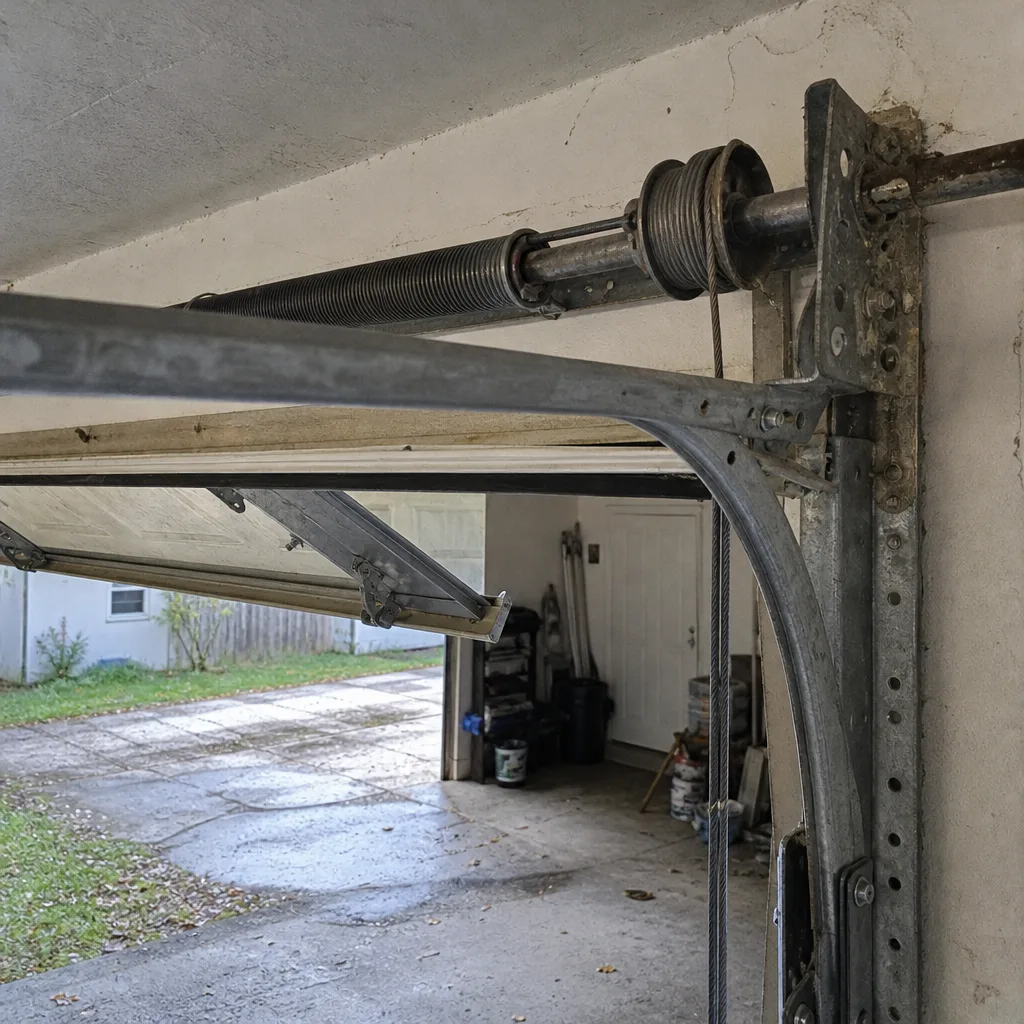 Before
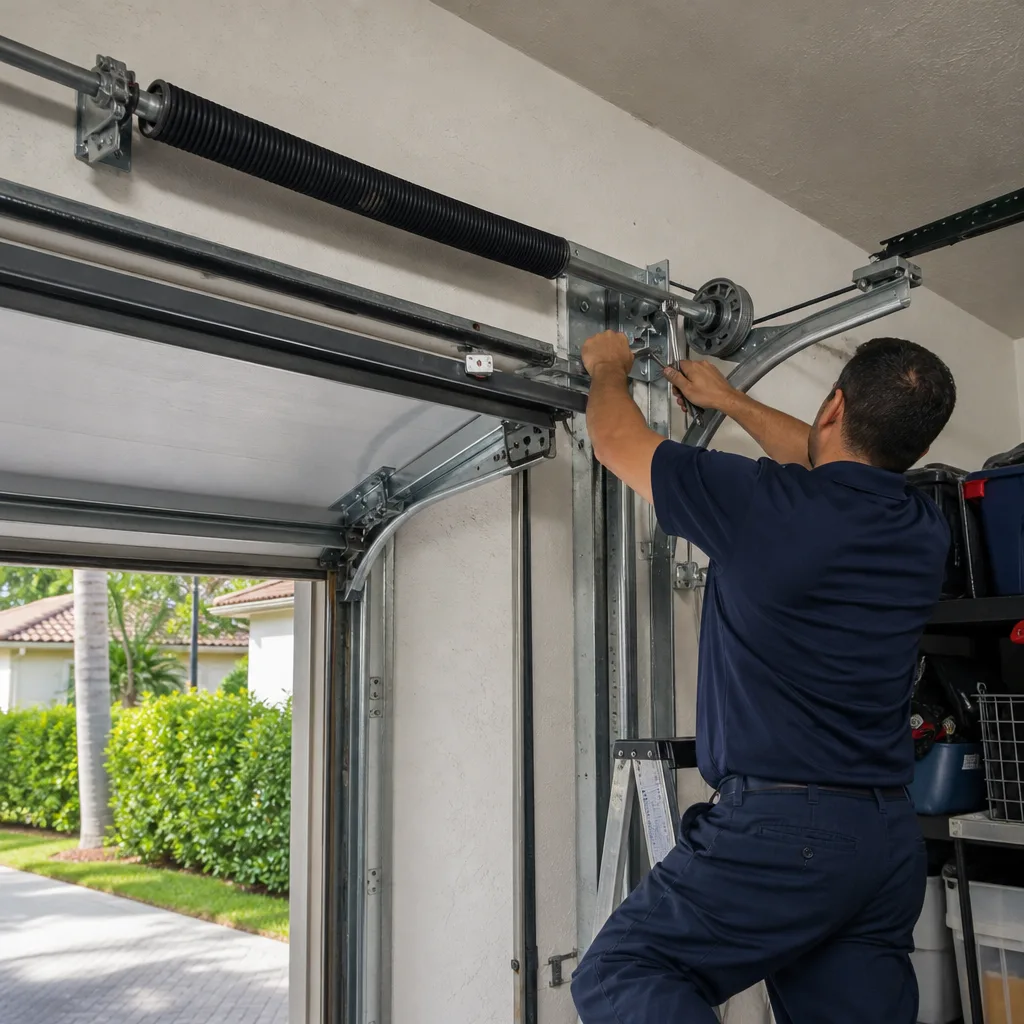 After
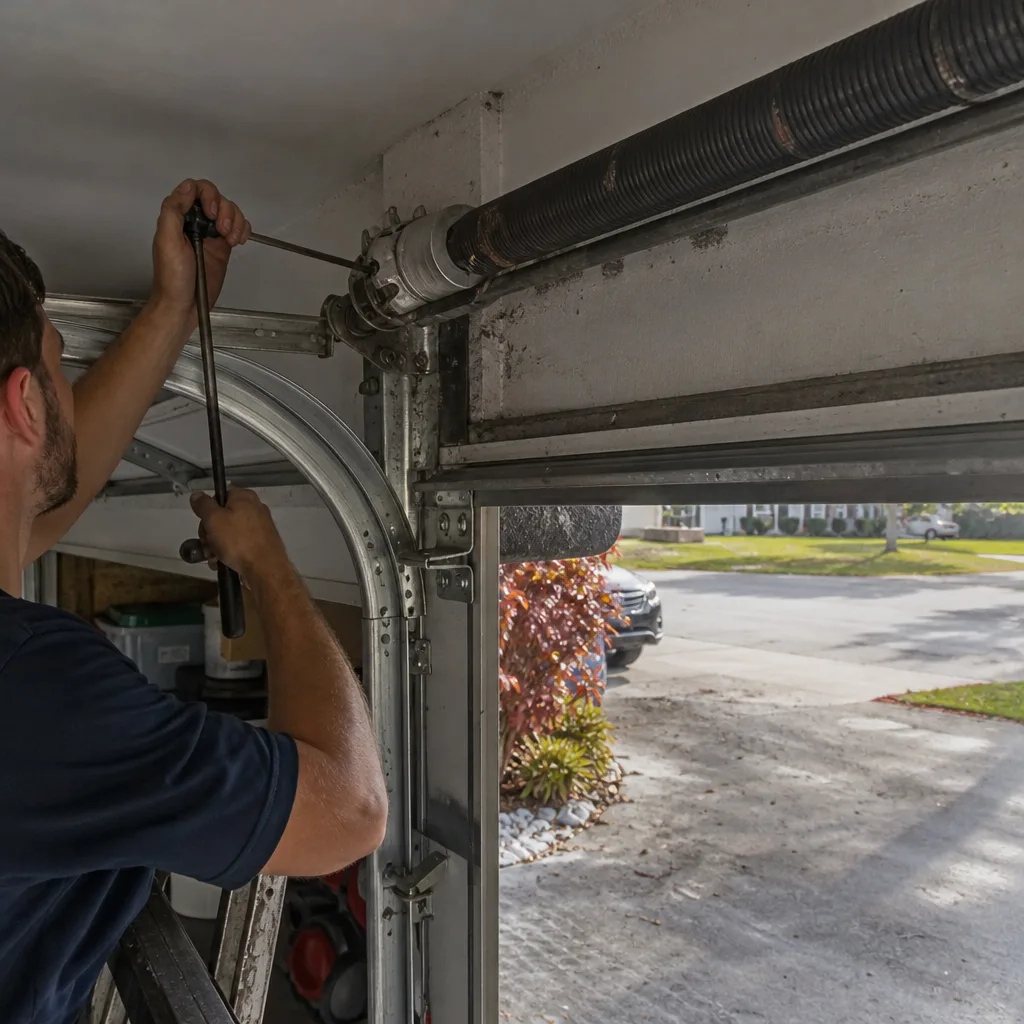 Before
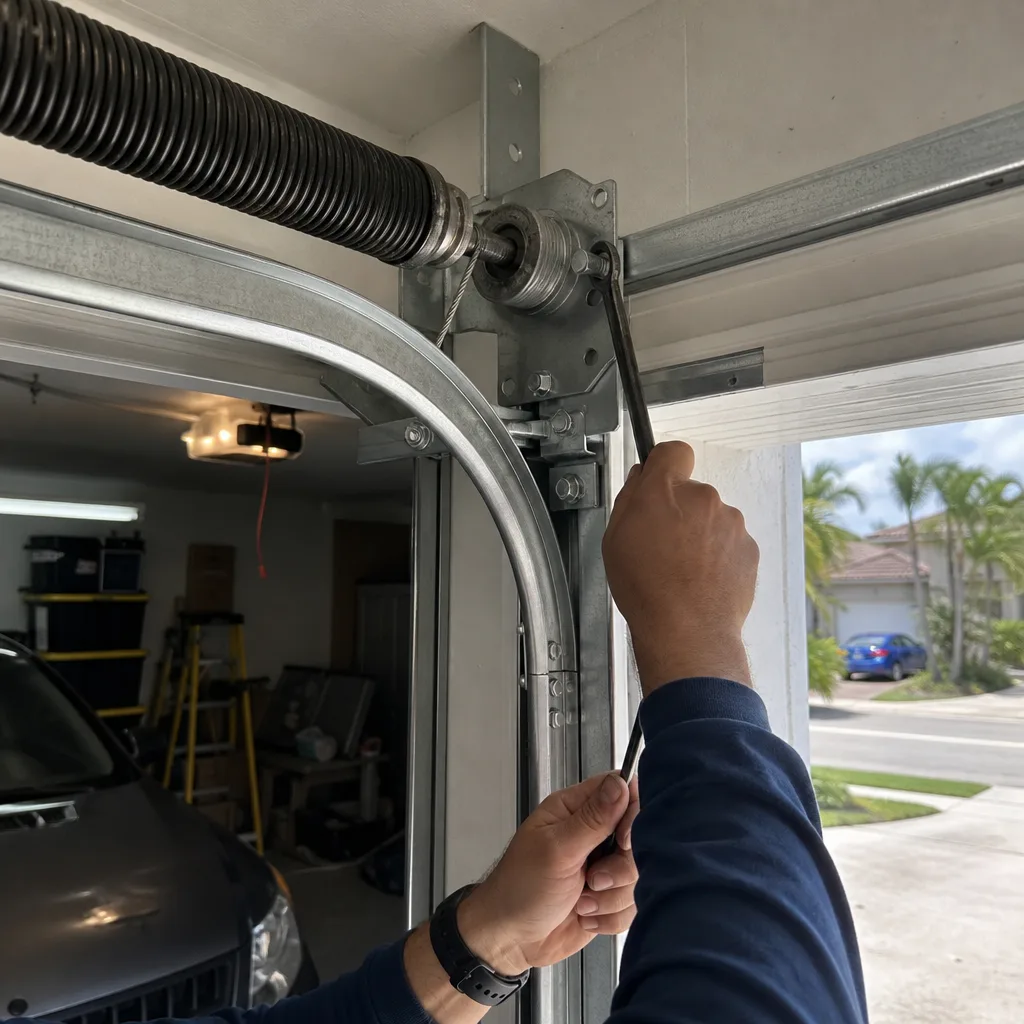 After
Frequently Asked Questions
If your door carries a Miami-Dade NOA label and was installed after the current Florida Building Code took effect, it has been tested to a design pressure rating appropriate for its location. You can verify this by looking for the metal label on a door panel. If the label is missing or the door predates the code, it may not be hurricane-rated. Kingsway Garage Door can assess your door and tell you exactly what you have and what it’s rated for. Call (866) 282-5541 for a free estimate in Miami.
Yes, if the door is fully closed and the springs are in good condition. Pull the red emergency release cord to disengage the opener, then lift the door by hand using the handles or bottom edge. Never pull the release while the door is open, because that can bind the mechanism and leave the door stuck. If the door feels heavy or drops when you release it, stop and call a professional rather than risking injury.
For a door that already carries a Miami-Dade wind-load approval, the Florida Building Code considers it sufficient without supplemental bracing. For older or unrated doors, you can install a code-approved vertical bracing kit, build a temporary 2×4 bracing system anchored to the floor and header, or park a vehicle against the inside face of the door as a last resort. The bracing kit is the only method that comes close to matching the tested performance of a rated door.
Typically yes, if the damage is storm-related and well-documented. Take wide and close-up photos of the door, panels, tracks, springs, and any water intrusion before any repair work begins. Adjusters look for a consistent damage pattern and will want to know whether the hardware was in good condition before the storm. If your door needs full replacement and the old door was wind-rated, the insured replacement should also be wind-rated, which is considered like-for-like restoration.
Inspect the exterior for panel damage and debris, check the interior tracks are aligned, examine the springs and cables for slack or breakage, and test the door manually at the midpoint before re-engaging the opener. In coastal Miami neighborhoods, also check for saltwater intrusion and rinse or lubricate the hardware if saltwater came into the garage, because corrosion will accelerate within months.
Eight. Our technicians diagnose and repair garage doors and openers from LiftMaster, Chamberlain, Genie, Clopay, Amarr, Wayne Dalton, Craftsman, and Raynor. That matters because the emergency release, the spring system, and the track hardware are not all identical, and a technician who knows all eight brands can tell you what’s repairable and what’s not. We don’t push replacements. We fix what you have when it’s fixable.
The Bottom Line
Miami’s garage doors are the largest opening in the house and the one most likely to fail first in a hurricane. The preparation isn’t complicated: know how your emergency release works, confirm your door’s wind-load rating, inspect the hardware before storm season, brace older doors properly, and document any storm damage before you touch anything. Ninety percent of the garage door failures we see after storms are doors that had an existing problem nobody noticed, whether a frayed cable, a worn spring, or hardware corrosion from salt air. If you’re not sure what you have or what shape it’s in, that’s what we do. We work on what you have, across eight brands, and we’ll give you an honest assessment without pushing a replacement you don’t need. Kingsway Garage Door serves all of Miami with garage door repair, opener repair, and new door installation.
Written by the team at Kingsway Garage Door, serving Miami since 2015.